

messari_ prefix.
You can use it to:
- Pull latest or historical metrics
- Build dashboards and models
- Compare assets, networks, exchanges, and sectors
Installation
Install the add-on from the Google Workspace Marketplace: workspace.google.com/marketplace/app/messari.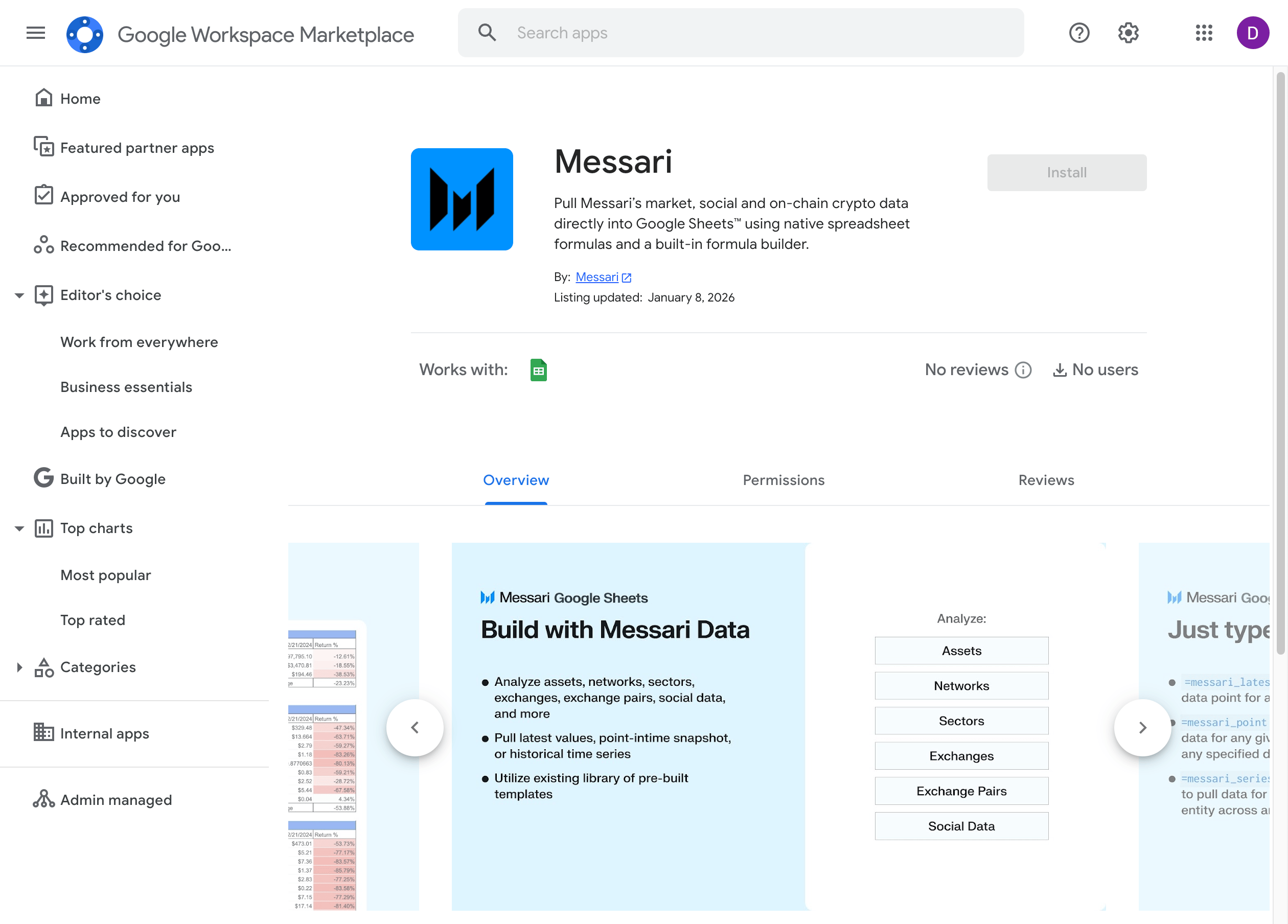
Launch the add-on
In the toolbar, go to Extensions > Messari > Open Sidebar.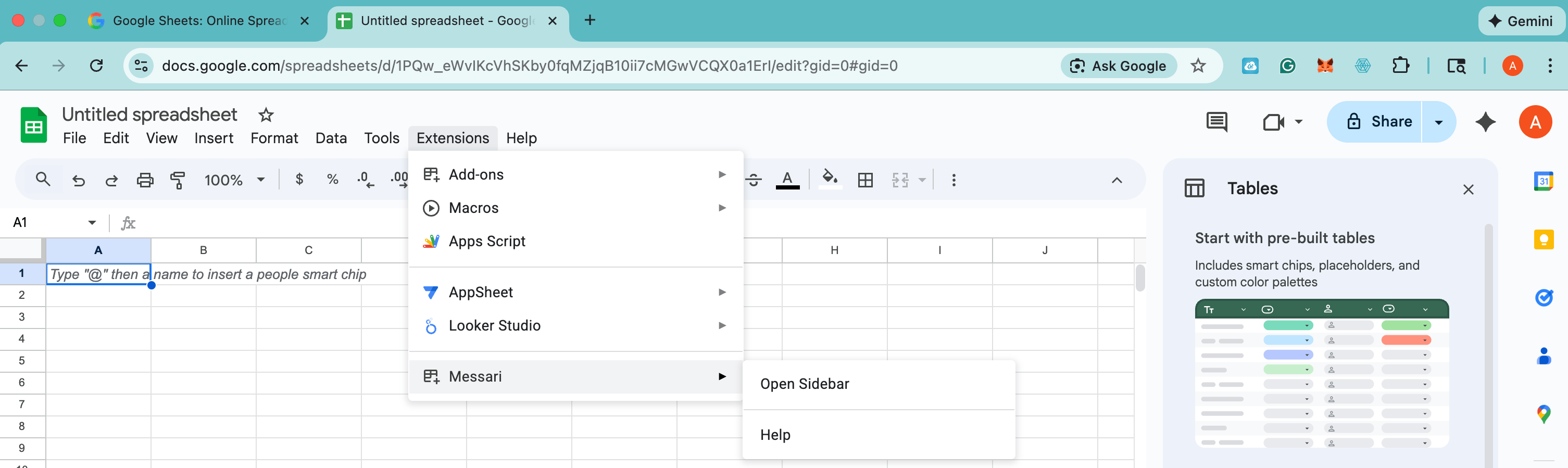
Authentication
After selecting Get Started, you are prompted to authenticate with your API key. Generate or view your key at app.blockworks.com/account/api. Once you have it, click Sign in and enter the key. Each user must authenticate individually. In shared spreadsheets, formulas only run for authenticated users.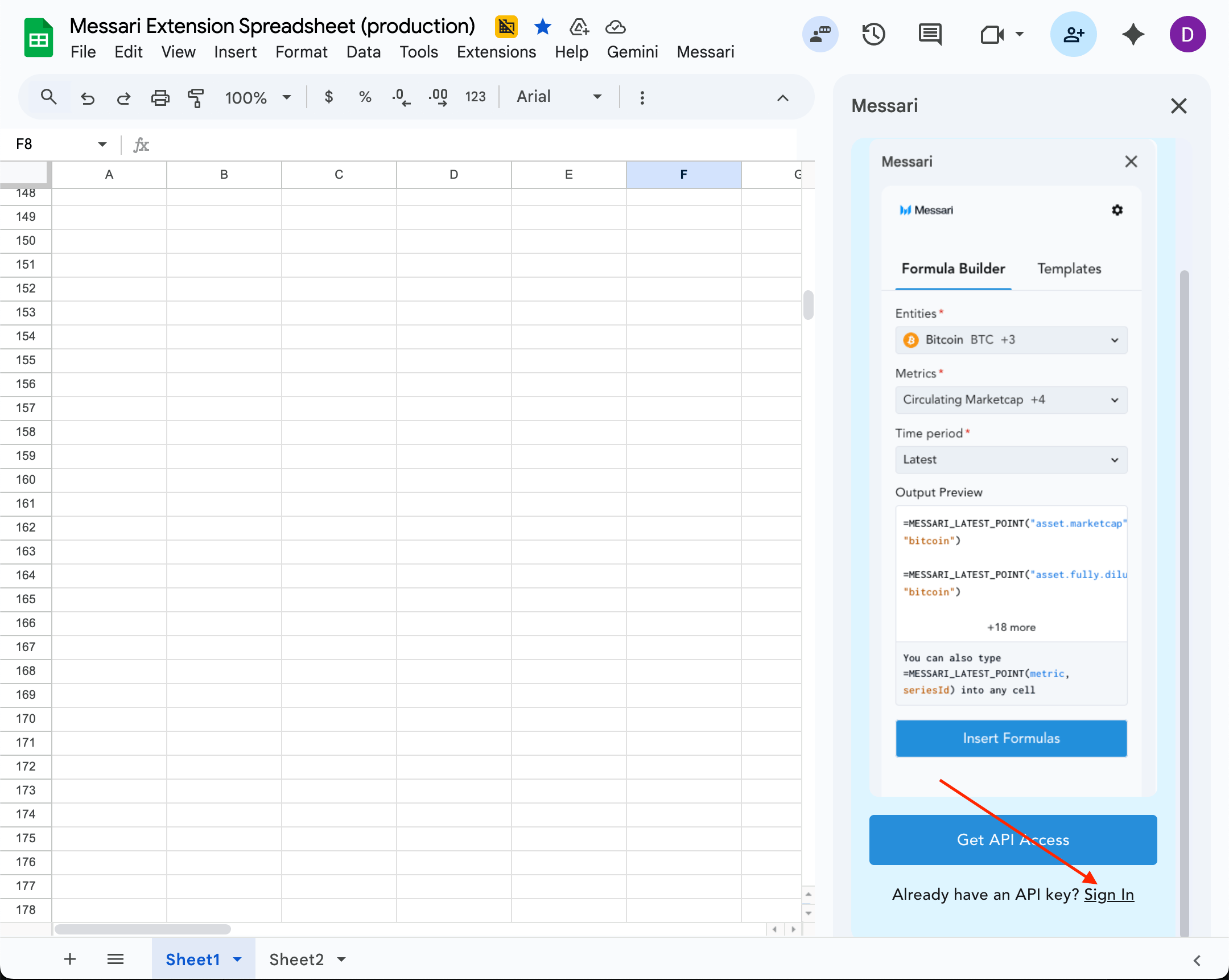
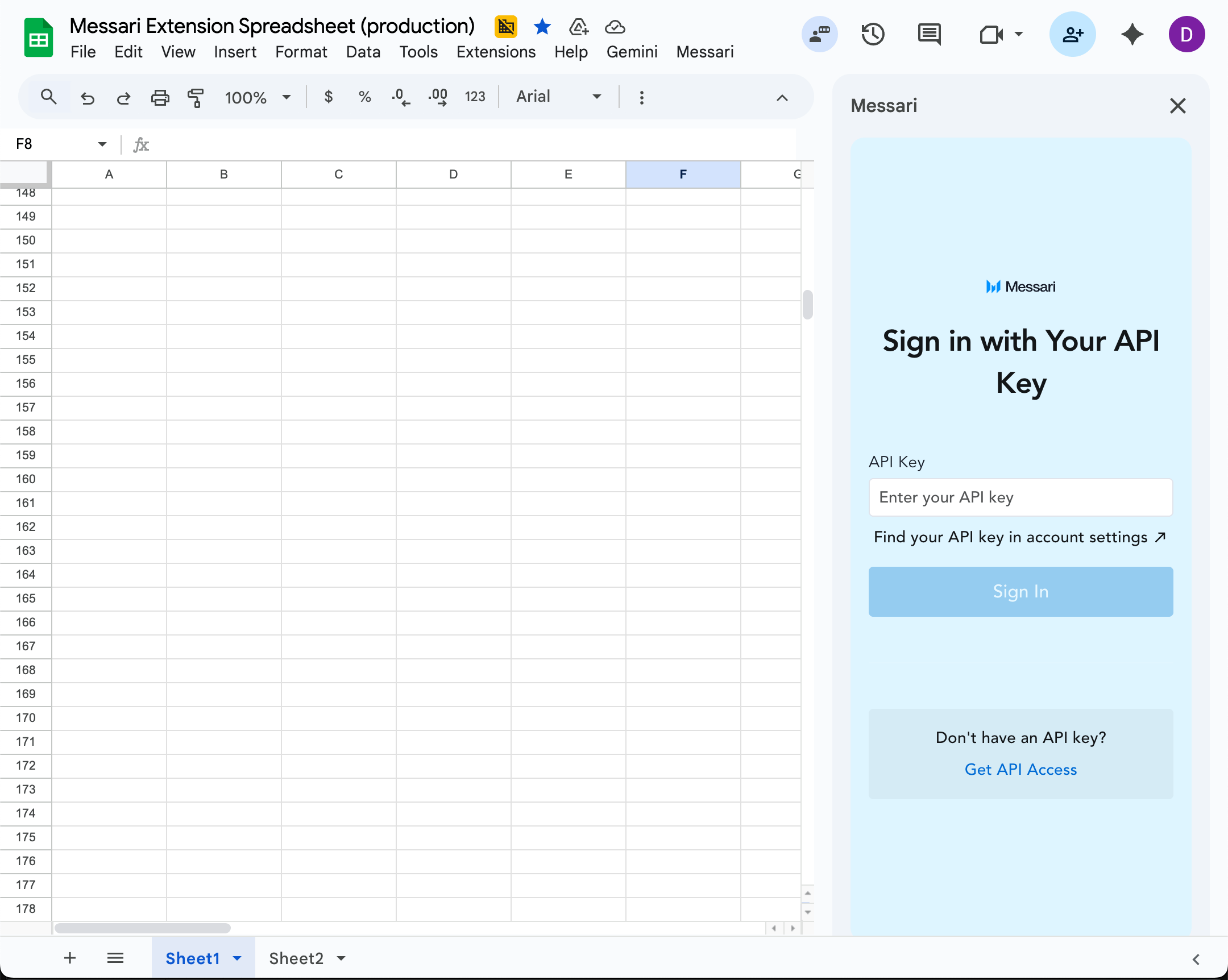
Using the Formula Builder
The Formula Builder is the easiest way to get started and to discover what data is available.1
Select an entity
Choose what you want to analyze:
- Assets
- Assets on a specific network
- Projects
- Projects on a specific network
- Networks
- Exchanges
- Exchanges on Networks
- Sectors
- Sub-Sectors
- Markets
2
Select a metric
After selecting an entity, choose a metric such as market cap, volume, price, TVL,
revenue, or mindshare.
If no metrics appear after selecting an entity, there may be no data coverage for
that entity and metric combination, or the metric may not be included in your API
access.
3
Select a time period
Choose how the data comes back: latest, a specific date, the last 7, 14, or 30 days, or
a custom date range.
4
Insert or copy the formula
Click Insert Formula to drop the formula into the selected cell. You can also copy
it and paste it into any cell manually.
Formula syntax
You can always write formulas directly without the builder.=messari_point
Returns the value for a specific date.
Syntax
=messari_latest_point
Returns the most recent daily value.
Syntax
=messari_series
Returns a time series over a date range.
Syntax
includeHeaders and includeDateCol are optional parameters.
Examples